INDUSTRIAL FACILITIES · RESEARCH-LED EXPLAINER
Industrial drone cleaning: a better brief for warehouses and facility exteriors
How facility teams can scope drone cleaning for warehouses and industrial exteriors, with clear operating zones, surface checks and wastewater planning.
THE SHORT ANSWER
Drone cleaning can be assessed for suitable industrial exterior surfaces, but the operating environment determines the scope. Loading activity, sensitive equipment, surface compatibility and wastewater arrangements need to be resolved alongside access, not after a flight date is chosen.
Define what industrial cleaning means on this site
The term industrial cleaning is broad enough to hide very different jobs. An exterior warehouse wash is not internal tank cleaning, confined-space work, process decontamination or a maintenance inspection. A drone-access proposal should state its boundaries in ordinary language.
Our recommended starting point is a marked site plan identifying the exact exterior elevations, structures or surface areas being considered. Add a short list of activities explicitly outside the enquiry. This prevents an apparently simple request to clean the facility from becoming an open-ended assumption about everything on the site.
If tanks, silos or unusual structures are included, request an individual assessment. Similar height does not make two assets equivalent. The facility's responsible personnel should identify process-related restrictions and any specialist input needed before the cleaning method is discussed as confirmed.
Describe a working day, not just an empty photograph
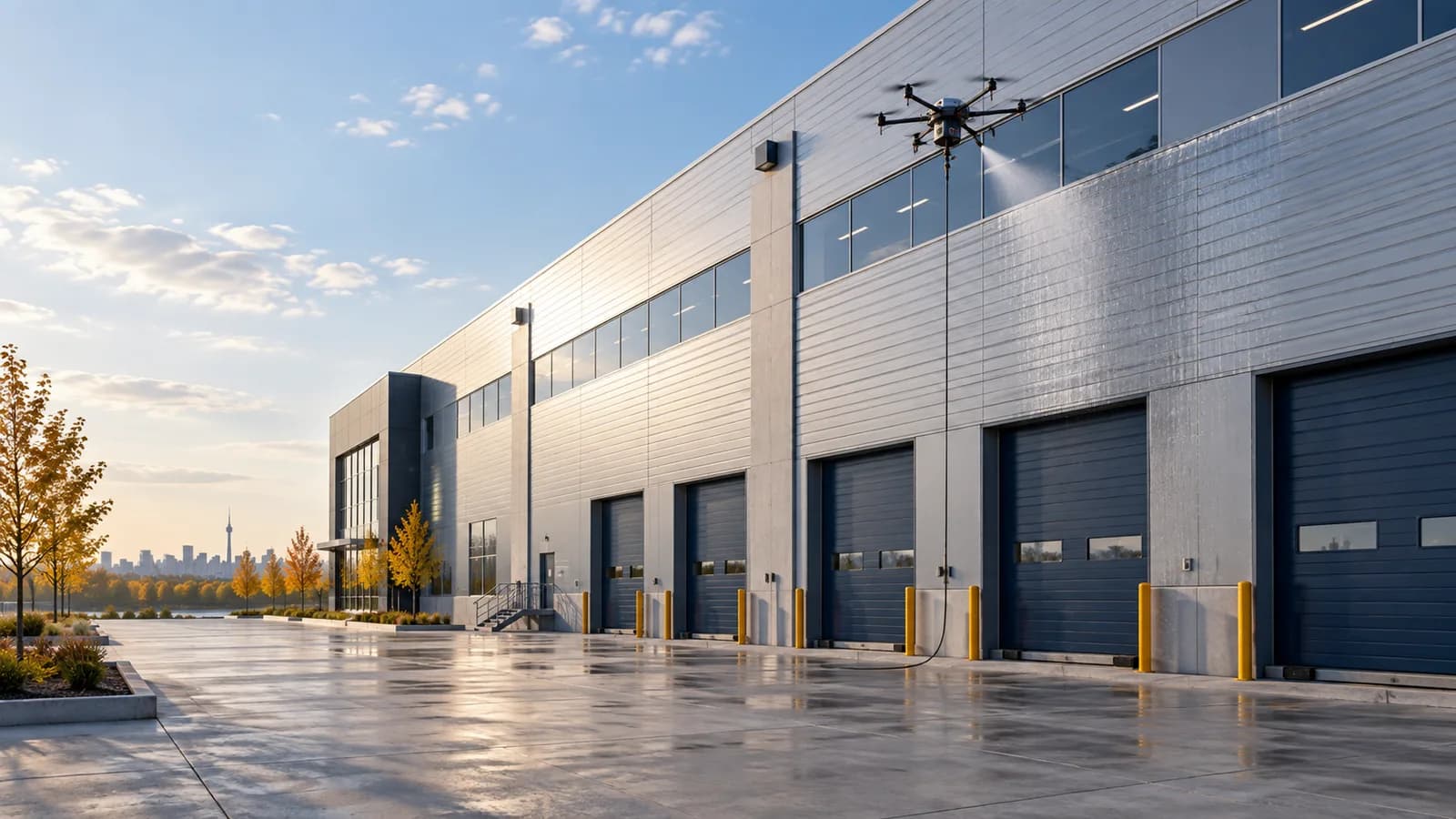
An empty loading apron in an enquiry photo may be a busy traffic area an hour later. Give the contractor the operational picture: shift changes, delivery periods, staff routes, access-controlled doors and areas that cannot be taken out of use without coordination.
CCOHS describes job safety analysis as breaking a task into steps, identifying hazards, determining controls and communicating the results. Applied to exterior cleaning, that is a reason to review setup, operation and reopening as distinct phases rather than treating the flight as the entire job.[CCOHS]
For example, the property team can ask who authorises a bay closure, who tells a delivery driver about the change and who confirms the route is ready to reopen. These are planning questions to resolve with the operator and facility team, not a substitute for their site-specific safe work procedure.
Separate ordinary dirt from a specialist problem
An enquiry should distinguish general exterior dirt from unknown residues, persistent staining, damaged finishes or suspected process contamination. Do not assume that increasing water force is the right response to an unidentified deposit. Ask the facility team to identify what it knows about the residue before choosing a treatment.
Sherwin-Williams' maintenance guidance emphasises approved techniques and products for its coated metal surfaces. On a warehouse, identifying the panel finish is therefore a useful step before approving an exterior wash.[Sherwin-Williams]
CCOHS's washing guidance identifies pressure-washer hazards including electrical exposure, spray injury and splatter, and calls for attention to equipment instructions and product safety information. It is general cleaning guidance, not a drone operating procedure; those hazards still deserve attention when a different access system delivers the wash.[CCOHS]
Use zones to make the proposal reviewable
The following is an illustrative planning matrix. It is deliberately phrased as questions so the site's authorised team can decide the controls rather than inherit assumptions from a generic article.
Scroll the table sideways to compare all columns.
| Area | Question for the facility team | Record before work |
|---|---|---|
| Loading-bay elevation | When can the affected operating area be made available? | Approved work window and responsible contact |
| Staff or visitor entrance | How will access be maintained or redirected? | Agreed route and communication arrangements |
| Equipment beside the wall | What restrictions apply to nearby equipment? | Facility-authorised protection or coordination |
| Drains and collection points | Where would wash water travel? | Agreed containment and disposal plan |
| Uncertain deposits | Who can identify the material? | Assessment decision and scope exclusions |
The water leaving the job is part of the job
The City of Toronto states that outdoor-washing wastewater must not reach catch basins, and notes responsibilities for both the hiring party and the wash business. Its guidance also says an indoor discharge may need treatment to meet sanitary-sewer limits. A drain is not automatically an acceptable disposal route.[City of Toronto]
Before pricing is finalised, ask for a plan that identifies the collection area, expected route and disposal arrangements. Elsewhere in Ontario, check the relevant local requirements rather than treating Toronto's guidance as a province-wide permit.
A claim that a process uses only water does not answer the question of what the water carries after touching the building. The scope should deal with the actual surface and site, not only the product arriving in the contractor's tank.
Compare complete proposals and define the handover
Compare the same elevations, exclusions, operational arrangements and finish requirements across bidders. A headline cleaning rate is difficult to interpret if one proposal includes coordination and detailing while another assumes the customer will arrange them separately.
Ask how weather changes, unavailable areas or unexpected findings will be handled commercially and operationally. Agree a contact who can make decisions on the day. This is more practical than promising that a working industrial site will experience no disruption under every condition.
At completion, record the areas cleaned, any areas deferred and the observations referred back to the facility. Keep those records with the site's maintenance information. The next enquiry then starts with a defined asset history instead of an unlabelled photograph and a guess about the previous scope.
Common questions
Can the warehouse remain operational during cleaning?
Possibly, but only where the facility and operator can agree suitable working areas and coordination. Some routes or bays may need temporary changes. Do not assume zero disruption.
Does this include cleaning inside tanks or silos?
No. This article concerns exterior assessments. Internal cleaning, confined spaces and process-related work need separate specialist scopes.
Can water-only cleaning be discharged into a storm drain?
Do not assume so. Toronto's guidance includes contaminants dislodged by water-only washing. Confirm the applicable requirements and disposal plan for the actual site.
FOLLOW THE EVIDENCE
Sources & further reading
Source-checked September 11, 2026. Manufacturer guidance applies to the products it describes. Planning recommendations are our synthesis, not claims of independent testing or documented project results.
- Job Safety AnalysisCCOHS
- Garages: washing and cleaning, including pressure-washer hazardsCCOHS
- Coil and extrusion coatings: cleaning and maintenanceSherwin-Williams
- Washing Cars & Outdoor Surfaces: business wastewater requirementsCity of Toronto